About the Book
Title: Pigeon English
Author: Stephen Kelman
Publication: Bloomsbury (2011)
Summary: Newly arrived from Ghana with his mother and older sister Lydia, Harrison absorbs the many strange element of city life, from the bewildering array of Haribo sweets, to the frightening, fascinating gang of older boys from his school. But his life is changed forever when one of his friends is murdered. He decides to take it upon himself to find the killer.
What I Think
I borrowed this book from a friend at work and was interested to learn that it had been shortlisted for The Man Booker Prize 2011, along with five others: The Sense of an Ending by Julian Barnes (the winning novel), Jamrach's Menagerie by Carol Birch, The Sisters Brothers by Patrick de Witt, Half Blood Blues by Esi Edugyn and Snowdrops by A.D. Miller. A shortlisting for this highly prestigious prize is, in itself, a massive achievement, and I therefore had high expectations of this novel.
Harrison, the main character, a young boy who has recently moved to England from Ghana is utterly adorable and has a unique perspective on things. I enjoy reading books written from a child's perspective. If the author is able to capture the wonder that children have about the world and how they see things, it makes for a very interesting read.
Have you heard of YouTube? It's a place on the internet just for films of things eating each other. Dean showed me a snake eating a boy.
When people speak a language that isn't their mother tongue, they quite often say things differently to native speakers. Kelman has thought up some interesting ways to define Harrison's use of language.
I got a remote control car even if it wasn't my birthday. Asweh it was dope-fine.[...]
Me: 'Stop snapping me, you're making me crash!'
Lydia: 'Stop crashing, you're making me snap you!'
Harrison is in an unfamiliar place, a place far more dangerous than he is used to, and he is too young to understand what is going on around him. This lands him in trouble. His sister is friends with girls who have links to an extremely nasty crowd. His aunt is living with a man who deals with violence every day. When Harrison, along with his best friend Dean, start looking for clues to find the killer of their friend, they bite off way more than they can chew.
I followed the word with my fingers to feel for a clue. It was only pretend: I knew already who did it and who it was meant for. Jordan's always writing warnings with his war knife, it shows the enemy he means business and freaks them out.
This is a very powerful novel about youth, displacement and trying to survive in an ever changing world full of people you love, but also full of people you can't trust. Highly recommended.
About the Author
Stephen Kelman was born in Luton in 1976. Pigeon English, his first novel, was shortlisted for the 2011 Man Book Prize, the Desmond Eilliott Prize and the Guardian First Book Award, and he was also shortlisted for the New Writer of the Year Award at the 2011 Galaxy National Book Awards. he lives with his wife Uzma in st Albans, where he is currently work on his second book.
About the Book
Title: Half Blood Blues
Author: Esi Edugyan
Publication: Serpent's Tail (2011)/Amazon Kindle
Summary: In Half Blood Blues, Esi Edugyan weaves the horror of betrayal, the burden of loyalty and the possibility that, if you don't tell your story, someone else might tell it for you. And they just might tell it wrong ...
What I Think
I wanted to read this because it had been shortlisted for The Man Booker Prize 2011, along with five others: The Sense of an Ending by Julian Barnes (the winning novel), Jamrach's Menagerie by Carol Birch, The Sisters Brothers by Patrick de Witt, Pigeon English by Stephen Kelman and Snowdrops by A.D. Miller. A shortlisting for this highly prestigious prize is, in itself, a massive achievement, and I therefore had high expectations of this novel.
Set in Berlin and Paris at the beginning of World War II, a group of musicians are brought together by not much other than their shared love of jazz. Sid (on bass) and Chip, friends since childhood in Baltimore, had travelled to Germany to escape the Jim Crow laws governing 1920s America. Paul (a Jewish pianist), Ernst (club owner of the Hound) and Fritz (a blond Bavarian) were all Germans, as was Hieronymous 'the kid' Falk. Hiero was also black, a Mischling, a half-blood, and a mean trumpeter, due to play with Louis Armstrong in Paris. Throw into the mix Delilah Brown, a singer who gets Sid's blood pumping faster than Paul's nimble fingers on the ivories. The political, personal and professional tension is running high, and people don't always cope well in those kind of circumstances.
"Don't get me wrong - I loved Berlin. I ain't saying otherwise. And for awhile the Housepainter didn't even seem as bad as old Jim Crow. Least here in Europe a jack felt a little loved for his art - even if it was a secret love [...] Cause blacks just wasn't no kind of priority back in those years. I guess there just wasn't enough of us."
Although the main events are surrounding Hiero, this is Sid's story. He has a strong voice, which is heavily accented. This sometimes makes for slow reading as you need to concentrate to work out what he is saying. Add to that the heavy subject matter and this was not an easy read. However, it was very satisfying and I would highly recommend it to anyone interested in the era, jazz, or a darn good story.
About the Author
Esi Edugyan is a graduate of the University of Victoria and Johns Hopkins University. Her work has appeared in several anthologies, including Best New American Voices 2003. Her debut novel, The Second Life of Samuel Tyne, was published internationally. Half Blood Blues, won the 2011 Scotiabank Giller Prize for Fiction. It was a finalist for the Man Booker Prize, the Governor General's Literary Award for Fiction, the Rogers Writers Trust Fiction Prize, and was longlisted for the 2012 Orange Prize for Fiction. She lives in Victoria, British Columbia, with her husband and daughter.
About the Book
Miles Garth, a guest at a dinner party, locks himself into the upstairs bedroom between the main course and desert. Despite enthusiastic coaxing from the other guests, he stays put and as days turn into weeks and then months, his isolation has an effect on many people's lives.
What I Think
I was recommended this book by my sister and I wasn't disappointed. It took me a little while to get the title straight, as it's unusual to say the least and doesn't make sense, but this leads to curiosity. Once I started reading it I realised that the book is divided into four sections: There, But, For, The. Now it was clear!
Each section is written from a different person's point of view and each character has his or her own voice. A very distinctive style has been used for the different sections. If you opened the book at any random page, you'd know whose story you were reading.
Each character has a link, albeit sometimes not a close one, to the main character, Miles. Smith has cleverly used the other characters and their interactions with Miles to disclose more about him and his life and the reasons as to why he's locked himself in the upstairs bedroom of a stranger's house.
About the Author
Ali Smith was born in 1962 in Inverness. She studied at the University of Aberdeen and lectured at the University of Strathclyde until she was diagnosed with CFS/ME. After her diagnosis she became a full-time writer and writes for The Guardian, The Scotsman and the Times Literary Supplement. She is the author of Hotel World (2001), The Accidental (2005), Girl Meets Boy (2007) and There But For The (2011) as well as short story collections and plays. Both Hotel World and The Accidental were shortlisted for the Man Booker Prize as well as the Orange Prize for Fiction.
About the Book
This wonderfully clever debut novel (by the now fully-established David Mitchell) takes you on a roller-coaster journey of humanity through nine separate, yet interlinking characters and places.
What I think
I love books that allow you discover different countries and cultures. For that, this book is amazing! It starts out on a small island off the coast of Japan and takes us to Tokyo, Hong Kong, 'Holy Mountain', Mongolia, St. Petersburg, London, a tiny Irish island and New York. As the journey through the different cultures and minds of different people progresses you find yourself asking what it is we are looking for in life.
As a writer it is sometimes hard to find an individual 'voice' for each of your characters, but this is something that Mitchell does extremely well. At the beginning of each new chapter, each new character has a distinctly different voice. If you flicked through the book and stopped randomly on a page, you'd know immediately which character you were reading.
I loved the fact that the chapters could be standalone short stories but they were simultaneously interconnected. I found myself constantly looking for clues as to how the latest chapter would be linked to the last. If I have one negative comment, it's that some of the chapters were harder work than the others. Mitchell is obviously a very clever guy, but some of us are just not that clever. All the science was a little baffling at times, but I felt skimming some of these sections didn't detract from the overall picture.
About the Author
David Mitchell (b. 1969) is an English novelist. He obtained a degree from the University of Kent in English and American Literature followed by an M.A. in Comparative Literature.
He lived in Sicily for a year and in Japan for over eight years. He currently lives in Ireland with his wife and two children.
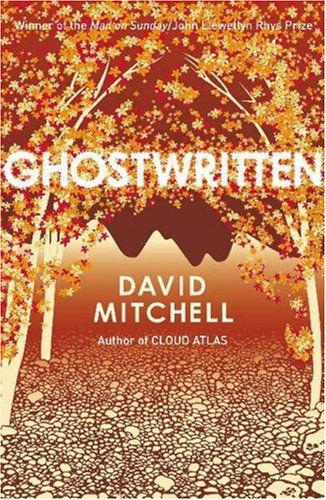
Ghostwritten (1999), the first of his five novels, won the John Llewellyn Rhys Prize. His subsequent two novels, number9dream (2001) and Cloud Atlas (2004), were nominated for the Man Booker Prize. He is also the author of Black Swan Green (2006) and The Thousand Autumns of Jacob de Zoet (2010).
About the Book
This book is told completely from the perspective of Jack, a five-year old who has spent every day of his young life locked in a shed with his Ma and doesn't know anything about what's beyond its walls.
What I think
This book is phenomenally clever. Not only does it take considerable effort to think about how a 5-year old would view things, but Donoghue has invented a language for him that makes it even more credible. On top of that, she has had to invent the way Jack would view things he's never seen "in Outside" before.
The premise of this book is harrowing but, due to the fact that it's told through Jack, who doesn't understand what is going on, it's not uncomfortable to read. There are moments, obviously, when you get a chill as you are reminded of the dark and inhumane setting of the story, but this is not the essence of the book.
The essence is the extremely strong bond between this mother and her son and what they are prepared to do for each other. There are struggles, as with any other parent-child relationship, but ultimately it is this bond, this love, that allows them to survive.
About the Author
Emma Donoghue (b. 1969) grew up in Dublin, Ireland, and attended Catholic convent schools, apart from one year in New York at the age of ten. She graduated from University College Dublin in 1990 with a first-class degree in English and French. In 1997 she received her PhD from the University of Cambridge. She has worked as a writer (of drama, literary history, short stories and fiction) ever since. Room was a finalist for the Man Booker Prize (2010) losing out to Howard Jacobson's The Finkler Question.
About the Book
This is the story of a man, Tony Webster, who is looking back on his life. Recent events cause his outlook on certain past events, and indeed his entire life, to change.
What I think
This is not a lengthy book and I put off buying it for several months, despite wanting to read it, due to cost. I generally buy books for my kindle now (even though I still love 'real' books) due to convenience. Living in Hong Kong it's not always easy to find titles and even if you can find/order them, the prices are often inflated. Initially this book was priced at over £6.00 and for an e-book I have real trouble paying that kind of price. Is this just me?
However, the cost came down and I bought it and recently read it. It's not a 'light' or 'easy' read, more of a challenge I'd say, and I'd possibly go as far as to say a little pretentious. However, there is enough of a story to keep you interested and turning the pages. I liked the fact that I, as the reader, thought I was one step ahead of the main character, but I wasn't. The ending is still a shock and I love it when the authors are clever enough to enable that to happen.
There was a strong theme of love and life in this book. How do we love and how do we live. There was the 'ordinary' vs. the 'extreme'. I felt questions were raised about how much control you have over your life and how much your life controls you.
About the Author
Julian Barnes (b. 1946) was born in Leicester and was educated at the City of London School from 1957 to 1964 and at Magdalen College, Oxford, from which he graduated in modern languages (with honors) in 1968. He has worked as a lexicographer, a reviewer, literary editor and television critic. Barnes has written numerous novels, short stories and essays. He has received several awards and honors for his writing, including the Man Booker Prize for The Sense of an Ending (2011).